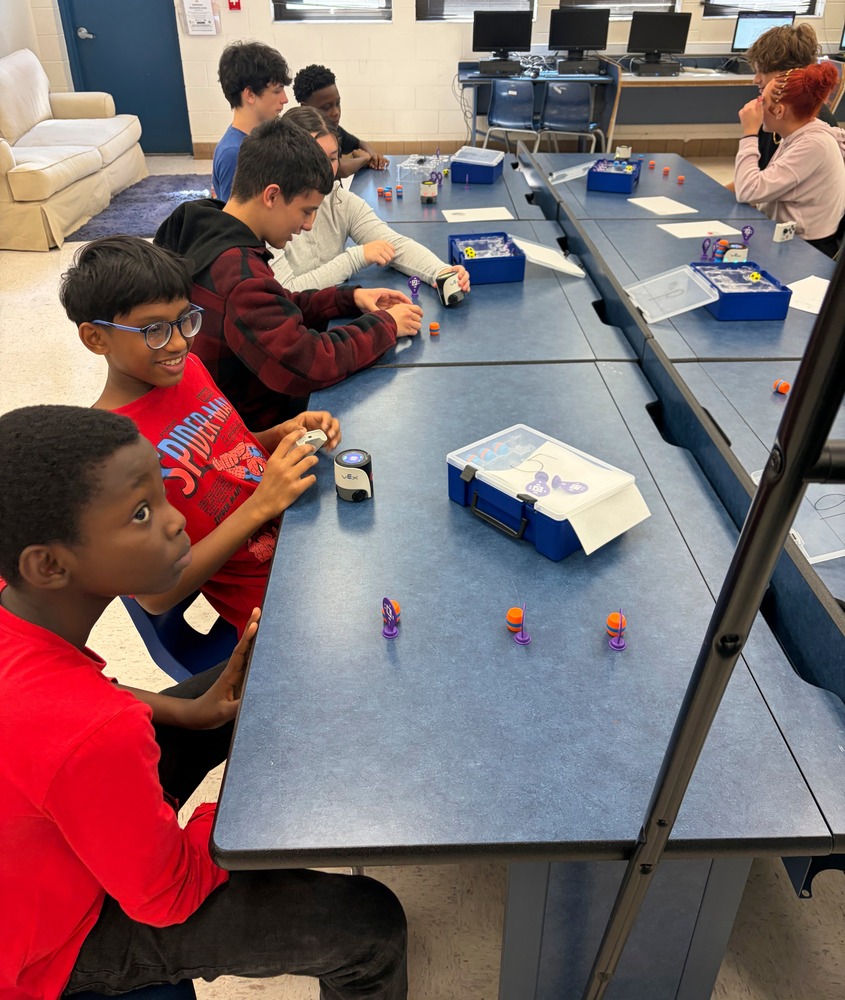
Students in Ms. Foster’s 7th- and 8th-grade coding classes got hands-on with their VEX AIM robots as they began exploring the fundamentals of robotics, coding, and problem-solving.
During the activity, students were introduced to their robots and given an opportunity to explore how the different components work together. Rather than simply being told how the robots function, students learned through hands-on exploration—observing how the robots responded to commands, testing different movements, and beginning to make connections between what they coded and what the robots did.
The goal of the activity was to give students an engaging introduction to robotics while encouraging them to think like engineers and computer scientists. Students practiced skills such as critical thinking, problem-solving, collaboration, sequencing, and computational thinking. They were encouraged to experiment, make predictions, test their ideas, and learn from what happened when their first attempt did not work as expected.
As students worked with the VEX AIM robots, they began to see that coding is more than simply writing instructions on a computer. Every command has a purpose, and even a small change in the code can change the robot’s behavior. This hands-on experience allowed students to immediately see the connection between their coding decisions and real-world results.
Ms. Foster said, “I wanted students to have the opportunity to explore the robots and learn through doing. When students can physically see their code come to life, coding becomes more meaningful and exciting. They are not just learning about technology—they are using technology to solve problems.”
She added, “One of the most important things students learn through robotics is that it is okay when something doesn’t work the first time. We want them to test, make adjustments, try again, and figure out what works. That process is a huge part of coding and engineering.”
The activity also gave students an opportunity to build confidence with technology while working alongside their classmates. As they explored the VEX AIM robots, students were encouraged to ask questions, share ideas, troubleshoot problems, and celebrate successful attempts.
“This is just the beginning,” Ms. Foster said. “As we continue throughout the year, students will move from simply exploring the robots to using their coding skills to complete challenges, create solutions, and apply what they have learned in increasingly complex ways.”
The VEX AIM exploration marks an exciting start to hands-on learning in Ms. Foster’s 7th- and 8th-grade coding classes, where students will continue to develop the technical and problem-solving skills needed for success in the rapidly changing world of technology.